




A quick reference guide for understanding LED lighting terms while you shop.
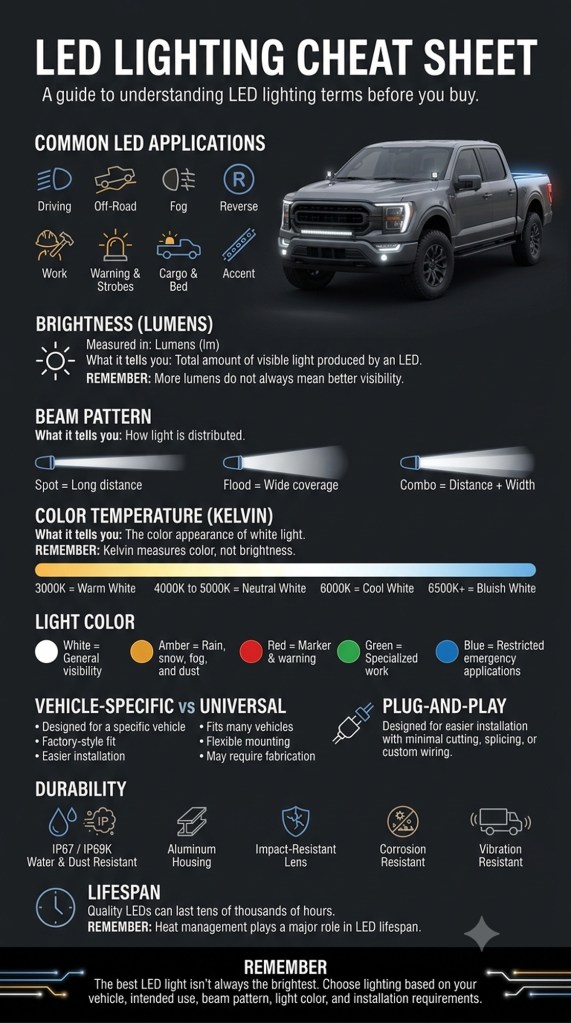
Shopping for LED lights doesn’t have to be complicated. Here’s a quick reference to the terms you’ll see most often and what they actually mean.
Whether you’re replacing factory lights, adding auxiliary lighting, or planning your next vehicle build, understanding a few key LED terms can make shopping much easier.
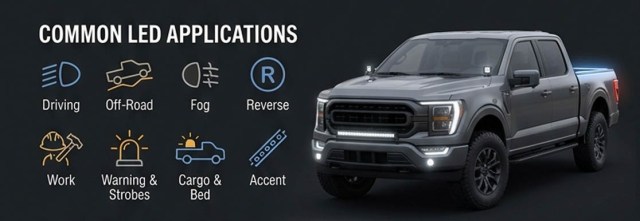
Common LED Applications
Whether you’re shopping for replacement bulbs or adding auxiliary lighting, these terms apply across many types of vehicle lighting, including:
- – Driving
- – Off-road
- – Fog
- – Reverse
- – Work
- – Warning & Strobes
- – Cargo & Bed
- – Accent
Remember: The best LED light depends on its intended application. The definitions below will help you understand the specifications you’ll see while shopping.

Brightness (Lumens)
Measured in: Lumens (lm)
What it tells you: The total amount of visible light produced by an LED.
Higher lumens generally mean more light output, but brightness alone does not determine performance. Beam pattern, optics, and how the light is mounted all affect how useful that light is.
Remember: More lumens don’t always mean better visibility.

Beam Pattern
What it tells you: How light is distributed from the LED.
Common beam patterns include:
- – Spot: Projects light farther for long-distance visibility
- – Flood: Spreads light across a wider area
- – Combo: Combines spot and flood patterns
- – Driving: Designed to supplement forward visibility
- – Fog: Provides wide, controlled lighting in poor weather
- – Work: Illuminates a broad area around the vehicle
- – Warning: Helps increase vehicle visibility
Remember: The right beam pattern depends on how and where you use your lights.

Color Temperature (Kelvin)
Measured in: Kelvin (K)
What it tells you: The color appearance of white light.
Color temperature describes whether white light appears warmer or cooler. It does not describe how much heat the light produces or how bright it is.
Common color temperatures include:
- – 3000K: Warm white with a yellow appearance
- – 4000K to 5000K: Neutral white
- – 6000K: Cool, crisp white
- – 6500K+: Bluish white
Remember: Kelvin measures color, not brightness.

Light Color
What it tells you: The color output of the LED and how it may be used.
Common light colors include:
- – White: General driving, reverse, and work lighting
- – Amber: Helps reduce glare and improve visibility in rain, snow, fog, and dust
- – Red: Common for marker, brake, and warning applications
- – Green: Used for specialized work, utility, and off-road applications
- – Blue: Restricted in many areas to authorized emergency applications
- – Dual-Color: Switches between two lighting colors
- – Tri-Color: Provides multiple lighting colors or modes
Remember: The best light color depends on your application and local regulations.

Vehicle-Specific vs Universal
What it tells you: How a light is designed to fit your vehicle.
- – Vehicle-Specific: Designed for a particular make and model, often providing an OEM-style fit and easier installation.
- – Universal: Designed to work across many vehicles and applications but may require additional mounting or wiring.
Remember: Vehicle-specific lights prioritize fit, while universal lights prioritize flexibility.
Plug-and-Play Installation
What it tells you: How easily a light can be installed.
Plug-and-play lighting is designed to simplify installation with minimal modifications. Many systems use vehicle-specific connectors, factory mounting locations, or dedicated wiring harnesses.
Remember: Installation requirements vary by product and application.

Durability
What it tells you: How well a light is designed to handle real-world conditions.
Features that improve durability include:
- – IP67 or IP69K water and dust resistance
- – Aluminum housings for heat management
- – Polycarbonate lenses for impact resistance
- – Corrosion-resistant finishes for harsh environments
- – Vibration-resistant construction for off-road use
Remember: A quality light should be built for the environment where it will be used.

Lifespan
What it tells you: How long a light is expected to operate.
Quality LED products can last tens of thousands of hours depending on design, components, operating conditions, and heat management.
Remember: Effective heat management is one of the biggest factors affecting LED lifespan.
Quick Comparisons
Amber vs White Lights
White lights:
- – Maximum overall illumination
- – Common for driving, reverse, and work applications
Amber lights:
- – Helps reduce glare in rain, snow, fog, and dust
- – Popular for off-road and adverse weather conditions
Remember: White maximizes visibility, while amber can improve comfort and contrast in challenging conditions.
Spot vs Flood Beam Patterns
Spot beams:
- – Narrow beam
- – Longer-distance visibility
Flood beams:
- – Wider beam
- – Better area coverage
Remember: Choose based on whether you need distance, width, or a combination of both.
Off-Road vs Street Legal Lights
Off-road lighting:
- – Designed for trails, private property, and recreational use
- – May not meet requirements for public road use
Street-legal lighting:
- – Designed to comply with applicable road-use requirements
Remember: Always verify local regulations before using auxiliary lighting on public roads.
How to Choose LED Lights
Start with these questions:
What is the purpose?
- – Driving
- – Off-road
- – Work
- – Warning
- – Reverse
- – Accent
Where will the lights be used?
- – Public roads
- – Trails
- – Jobsites
- – Private property
What type of light output do you need?
- – More distance
- – Wider coverage
- – A balance of both
What color works best?
- – White for general visibility
- – Amber for challenging weather
- – Other colors for specific applications
What installation style fits your vehicle?
- – Vehicle-specific for easier fitment
- – Universal for more flexibility
Remember: The best LED light is the one that matches your vehicle, environment, and intended use. Brightest does not always mean best.